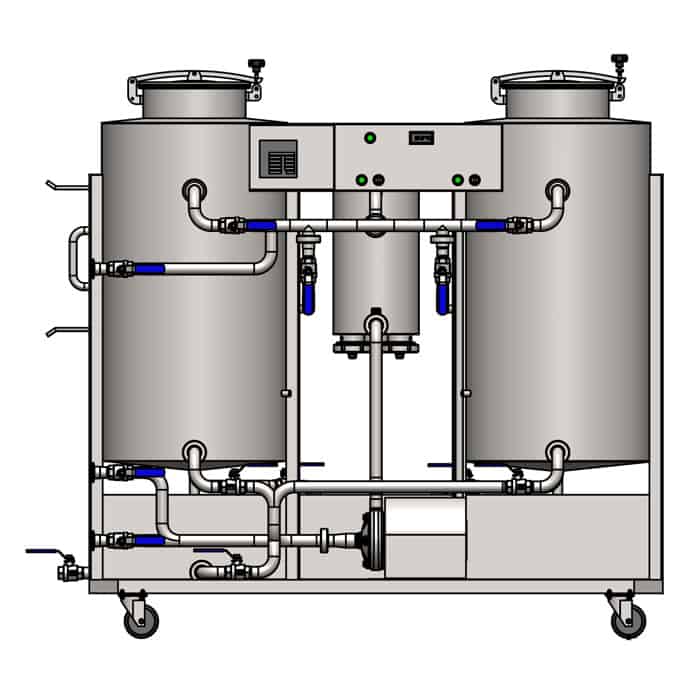
Many devices will have the word cleaning on them, often referring to CIP, and similarly, devices will have the word disinfecting or sterilizing on them, often referring to SIP. cleaning, disinfecting or sterilizing is a very broad concept and can be interpreted in such a way that CIP is a form of cleaning, and similarly, SIP disinfecting or sterilizing is a form of sterilizing.
This blog takes the purpose of SIP as a starting point, starting with the definition and differences between SIP and CIP, and centers on the process and points of note of SIP.
Definition of CIP and SIP
CIP (cleaning in place), which can be translated as cleaning in place, in-situ cleaning, positioning cleaning, etc., is usually abbreviated as cleaning.
CIP systems are widely used in a variety of beverages (milk beverages, fruit and vegetable juice beverages, fruit beverages, tea beverages), liquid milk, yoghurt, alcohol and other highly mechanized food enterprises. It is actually the cleaning of the inside of the production equipment, such as the inside of pipes and the inside of cylinders.
SIP (sanitizing in place), which can be translated as in-place sterilization, in-situ disinfection (sterilization), or positioning disinfection (sterilization), can also be called sterilizing in place.SIP system is also widely used in food enterprises with high mechanization such as beverages, liquid milk, yoghurt, etc.
It is actually the internal cleaning of production equipment, such as the inside of pipes, and inside of tanks. It is actually the disinfection or sterilization of the inside of the equipment, e.g., the inside of pipes, and the inside of tanks.
Differences between CIP and SIP
Purpose of SIP
To kill as many microorganisms as possible, note that SIP targets microorganisms.
Factors affecting the effect of SIP
What SIP has to do is kill as many microorganisms as possible, so the factors affecting the effect of SIP are temperature and time. If it is aseptic equipment, must be≥121 ℃, time≥20min. some can reach 135℃, 30min.
If not aseptic equipment, do SIP temperature does not need to be more than 100℃, the general requirement of more than 80℃. Practical application of the enterprise according to their own needs to set the parameters required.
SIP program design considerations
As part of the SIP program design, delivering saturated steam effectively is essential. This includes maintaining predefined temperatures on internal surfaces and addressing design aspects like heat transfer, steam supply, and air/condensate removal.
SIP performed for the purpose of system sterilization will require both physical and biological qualifications. Physical and biological qualifications should be performed simultaneously.
The destruction of a biological challenge alone is not sufficient evidence of the suitability of a cycle. The biological challenge data should support the physical data and vice versa.
What is Filter Designed Specifically for SIP?
To ensure the effectiveness of the SIP process, filters need to be specially designed to withstand high temperatures, humidity, and other conditions associated with the SIP process.
The design of these filters typically considers the following aspects:
High-Temperature Resistance: Filters need to use materials that can maintain stability at high temperatures to prevent failure or the release of harmful substances during the SIP process.
High-Efficiency Filtration: Filters must have high filtration efficiency to effectively remove microorganisms and other particulate contaminants during the SIP process.
Steam Impact Resistance: Since the SIP process involves steam impact on the internal surfaces of equipment and pipes, filters designed for SIP need to withstand these impacts without damage.
Prevention of Bacterial Intrusion: Filter designs should effectively prevent the reintroduction of contaminants into the system during the SIP process, ensuring the sterility of the product.
Sanitek’s CapsFlow SIP capsule filters are specifically designed for secure sterilization, encapsulating standard filters in robust plastic housings that maintain high strength and integrity even under high-temperature conditions.
Conclusion
Overall, the use of SIP in a variety of hygiene industries is a key component in ensuring product quality, regulatory compliance, and production efficiency, which is important for patient safety and enhancing corporate sustainability.
Production often requires highly pristine conditions, and SIP helps prevent the cross-transmission of microorganisms by sterilizing equipment and piping.
Sanitek is committed to providing innovative filtration solutions, offering filters designed for sip to enhance the safety and efficiency of your production process. Contact us today to explore advanced technologies to enhance your manufacturing capabilities.