Air Filtration
Compressed air plays a vital role in operating processing equipment, drying after rinsing, and pneumatically transporting products through pipelines.
However, as air compressors age, they often leak oil and moisture, which can serve as ideal food sources for microorganisms and shed metal flakes.
Adhering to standards such as Safe Quality Food (SQF) and the British Retail Consortium (BRC), which emphasize the importance of clean compressed air in food manufacturing processes, Sanitek offers tailored solutions for air filtration.
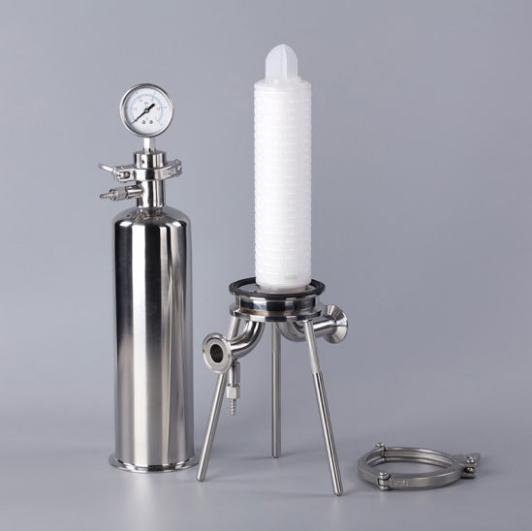
Our recommended vent filter and gas PTFE pleated cartridges feature a pre-filter designed to capture larger particles, effectively removing a significant amount of moisture and offering a filtration accuracy of approximately 0.45µm.
The gas PTFE filter acts as the final filter, effectively removing smaller contaminants with a filtration accuracy ranging from 0.1 to 0.22 µm.
Additionally, we offer a desiccant air dryer downstream to eliminate water vapor, creating an environment unfavorable for microbial propagation.
Liquid Filtration
Water is everywhere in pet food processing, from cleaning areas to ingredient and mixing tanks. It also feeds boilers to cook products, is used for industrial mixing and gravy injection, and provides mist for vitamin coatings.
Even if you use a clean water source, as a further precaution, the water line entering the process should be pre-filtered. Downstream of the process, final filters should be installed on water lines dedicated to washing, cooking, mixing or injection stations. Sterile input water will reduce the potential for contamination and ensure better product consistency.
Redundant Filtering
Have you ever heard of “redundant filtering”? Redundant filtration reduces the need for downstream point-of-use filters by removing larger contaminants with a pre-filter at the point of origin, thereby reducing the cost of maintenance and filter replacement.
It helps reduce the risk of different types of contaminants being generated at different points in the process. The use of “step-down” or graded filtration is not only effective in reducing the risk of contamination, it is also cost-effective.